Utah Firearm Laws
This page provides an overview of Utah firearm laws with short descriptions of the rules governing possession, carrying, transportation, purchasing, selling and lawful firearm use.
Each subject provides a summary of important information. For more detailed explanations, requirements and additional information, select the corresponding subject link to view its dedicated page.
Required
Carrying A Firearm In Utah
The rules most firearm owners need first.
Constitutional Carry & Open Carry
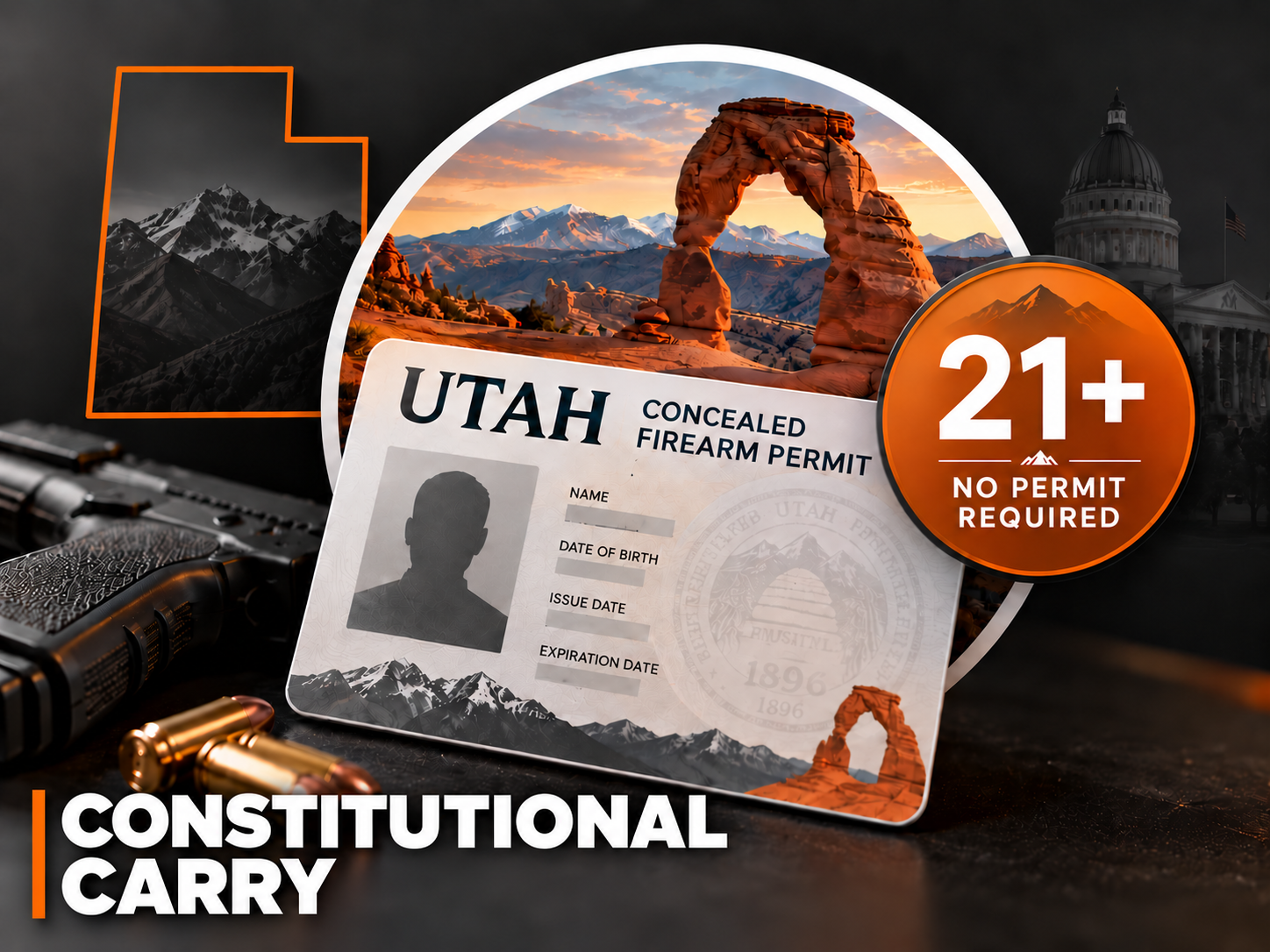
Utah allows individuals who are not prohibited under state or federal law to carry firearms without a permit. There are requirements that depend on age, location, and whether the firearm can be loaded or must be unloaded.
Minors & Firearms
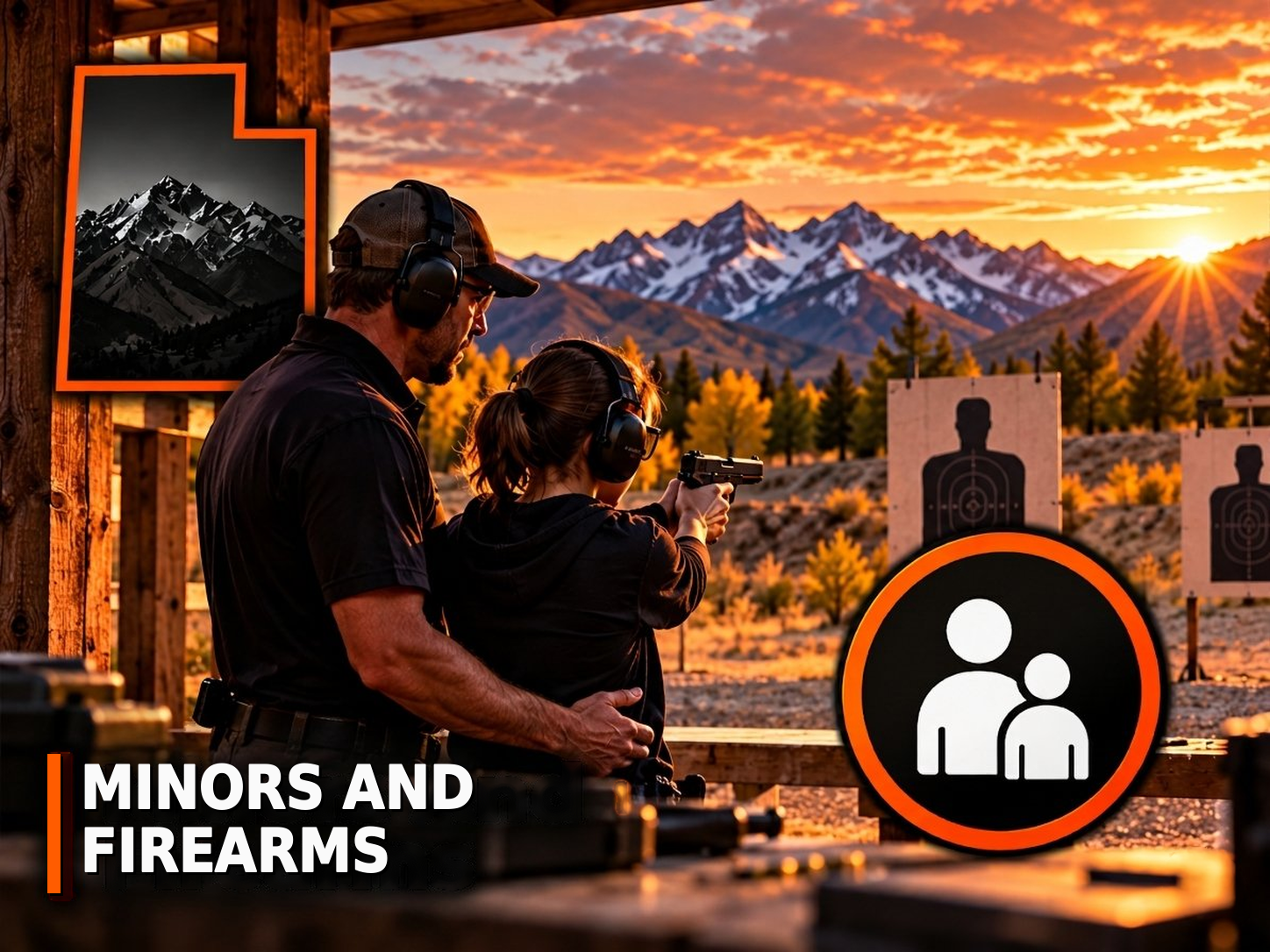
Utah law places specific restrictions on firearm possession by individuals younger than 18. Minors are prohibited from possessing certain firearms, including handguns, short-barreled rifles, short-barreled shotguns, fully automatic firearms and machinegun firearm attachments, except as permitted by law.
When Possession Is Legal: Utah law permits minors to possess firearms for certain activities, including firearm safety courses, target shooting, organized competitions, hunting and other activities when the required parental permission, supervision and legal conditions are met. Federal handgun restrictions also apply.
Where You Can & Cannot Carry
Constitutional carry does not eliminate restrictions on carrying firearms in prohibited locations.
Prohibited Areas
Utah and federal laws restrict firearms and other dangerous weapons in certain locations, with or without a permit. It is important to know where carrying is prohibited.
No Weapon Signs
Firearm restrictions and business policies on private property.
No Force Of Law
In Utah, “No Weapon” and “No Firearm” signs posted by private businesses do not have the force of law to prohibit firearms. However, property owners can restrict entry or require someone carrying a firearm to leave.
Schools
Firearm carry requirements for schools, daycares, colleges and universities.
Firearms On School Property
Whether a firearm may be carried on school property depends on the person's age, the type of school and whether the individual holds a Utah concealed firearm permit.
Gun-Free School Zones
Federal Law: The Gun-Free School Zones Act covers areas within 1,000 feet of the grounds of public, private and religious K–12 schools, with exceptions established in federal law.
Permit Requirement: Federal law provides an exception for a qualifying license issued by the state where the school zone is located. Other exceptions include an unloaded firearm in a locked container or locked vehicle firearm rack.
Utah Law: Utah's permitless carry rules and restrictions on actual school property are separate from federal school-zone requirements.
Ages 18–20
K–12 Schools: Prohibited, even with a Utah Provisional Concealed Firearm Permit, except where another legal authorization applies.
Daycares: Utah Provisional Concealed Firearm Permit required. Firearms must be concealed.
Colleges & Universities: Utah Provisional Concealed Firearm Permit required. Firearms must be concealed.
Ages 21+
K–12 Schools & Daycares: Utah Concealed Firearm Permit required. Firearms must be concealed.
Colleges & Universities: No permit required. Constitutional carry is permitted. Firearms must be concealed.
Open carry is prohibited on all school and daycare property unless lawfully responding to an active threat or another legal authorization applies.
Higher Education Hearing Rooms: Firearms are prohibited in a lawfully established secure hearing room at a college or university. Each institution may establish no more than one secure hearing room, with required entrance notices and secure weapons storage.
Churches
House Of Worship
House Of Worship
Churches, synagogues, mosques and other houses of worship may prohibit firearms when notice is provided in accordance with Utah law.
Home & Property
Firearm carry at home and in temporary accommodations.

Utah allows individuals who are not prohibited under state or federal law to possess and carry loaded firearms, openly or concealed, at home without a concealed firearm permit.
Carrying At Home
Loaded Firearms: Firearms may be carried loaded, openly or concealed, at home. A concealed firearm permit is not required.
Renters, Hotels, Motels & Camps
Rental Homes & Apartments: A lease prohibiting firearms is lawful. Violating a lease provision prohibiting firearms is a civil matter rather than an independent criminal firearm offense. A landlord can pursue eviction through the lawful eviction process for violating the lease.
Hotels & Motels: A room rented for temporary lodging is a temporary residence.
Camps: Utah's residence carry provisions recognize camps, including temporary places used for camping. A concealed firearm permit is not required to carry a loaded firearm at a qualifying camp.
Firearms At Work
Firearm carry at places of employment.

Individuals who may lawfully carry firearms under Utah law can carry at workplaces where firearms are not prohibited by state or federal law. Specific laws also govern firearm possession in designated secure areas and government facilities.
Lawful Carry At Work
Individuals who may lawfully possess and carry firearms under Utah law may carry at workplaces where firearms are not prohibited, including a business the individual owns or controls.
Employer Policies
An employer can establish workplace policies that prohibit employees from carrying firearms. An employee who violates company firearm policies can be disciplined or terminated for violating company policy.
Prohibited Locations
Carrying firearms is illegal in specific workplaces, buildings and secure areas prohibited by state or federal law.
Law enforcement officers, authorized security officers and certain other personnel can have legal authority to carry firearms in locations where other individuals cannot.
Traveling With Firearms
Firearm carry and transportation requirements in Utah and while traveling.
Police Encounters
What You Can Do
No Duty To Notify: Utah law does not require an individual lawfully carrying a firearm to voluntarily notify a law enforcement officer that the individual has a firearm.
Important Information
During an encounter with law enforcement, keep your hands visible and do not reach for a firearm. If asked about the firearm, communicate clearly and follow lawful instructions.
Vehicles
What You Can Do
Loaded Handguns: Individuals at least 18 who may lawfully possess firearms may have a loaded handgun in their vehicle or in another person's vehicle with the vehicle owner's consent.
What You Cannot Do
Rifles, Shotguns And Muzzle-Loading Rifles must be unloaded, unless an individual has a valid permit.
Vehicle Owner Prohibitions: It is illegal to carry a firearm in another person's vehicle without the required consent when the vehicle owner or lawful possessor prohibits firearms in that vehicle.
Parking Lots
What You Can Do
Vehicle Storage: Utah protects lawful transportation and storage of firearms in vehicles parked in many parking areas, including employer parking lots.
While the vehicle is unoccupied, the firearm must be securely locked in the vehicle or in a locked container attached to the vehicle, and the firearm must not be visible from outside.
What You Cannot Do
Federal Property: Federal laws and regulations prohibit firearms in certain federal property parking lots. Utah's parking-lot protections do not override those federal prohibitions.
Secure Employer Parking: An employer can prohibit firearms in a secured parking area when the employer provides either:
Option 1: Free alternative parking that is reasonably close and in a location where parking is lawful and safe.
Option 2: A secured and monitored storage location where an individual can securely store a firearm before entering the secured parking area.
Rental Property: Residential rental properties, including apartment complexes, can prohibit firearms in parking areas.
Buses
UTA Buses
Individuals who may lawfully carry firearms under Utah law may carry on UTA buses.
Greyhound
Greyhound prohibits firearms and other weapons on its buses, including firearms placed in passenger baggage stored under the bus.
Greyhound Firearm Policy ›
Trains
TRAX & FrontRunner
Individuals who may lawfully carry firearms under Utah law may carry on TRAX and FrontRunner trains.
Amtrak
What You Can Do: Firearms may be transported as checked baggage on Amtrak trains that offer firearm checked-baggage service.
Firearms must be unloaded and secured in an approved, locked hard-sided container. Amtrak requires advance notification and a signed declaration.
What You Cannot Do: Passengers cannot carry firearms on their person or in carry-on baggage aboard Amtrak trains.
Amtrak Firearm Policy ›
Restaurants & Bars
What You Can Do
Restaurants & Bars: Individuals who may lawfully carry firearms under Utah law may carry in restaurants and bars that serve alcohol.
What You Cannot Do
Under The Influence: It is illegal to carry or possess a firearm or dangerous weapon that is readily accessible for immediate use while unlawfully under the influence of alcohol or drugs.
Limited circumstances can make possession lawful, including situations involving lawful self-defense and other specifically authorized conduct.

Airports & Flying
What You Can Do
Flights Within The United States: Firearms may be transported in checked baggage on domestic flights when the airline transports checked firearms.
The firearm must be unloaded and secured in a locked hard-sided case.
The firearm must be declared to the airline at check-in. The airline's firearm declaration form must be completed and signed, then placed in the baggage or firearm case as directed by the airline.
All TSA requirements and the airline's firearm and ammunition transportation policies must be followed.
What You Cannot Do
Illegal Under State And Federal Laws: It is illegal to bring a firearm into or past an airport security screening checkpoint or into an airport secure area.
Carry-On Baggage: Firearms cannot be carried in carry-on baggage, backpacks, purses or other items taken through a TSA security checkpoint.
Concealed Firearm Permits: Having a Utah Concealed Firearm Permit or a permit from another state does not authorize an individual to bring a firearm into an airport secure area.
Failure To Declare: A firearm cannot be transported as checked baggage without following the airline's firearm declaration and packaging requirements.
Violations: Passengers may be subject to criminal charges, confiscation of the firearm, denial of firearm transportation in checked baggage, denial of boarding, fines issued by TSA, and additional security screening.

Parks & Forests
What You Can Do
State & Federal Land: Individuals who may lawfully carry firearms under Utah law may carry in Utah state parks, wildlife management areas, national parks and national forests.
What You Cannot Do
Federal Buildings: Firearms are prohibited inside federal buildings, including designated visitor centers, ranger stations and government offices.
Discharging a firearm, hunting or target shooting is illegal in locations where those activities are prohibited by state or federal law.
Buying, Selling & NFA Firearms
Purchases, private transfers, NFA firearms, shipping and Utah search resources.
Buying, Selling & Firearm Transfers
Federal and Utah laws regulate firearm purchases, sales, private transfers, NFA firearms and shipping. Additional requirements can depend on firearm type, residency and transaction.
Self-Defense Laws
Use of force, deadly force and defense of property.
Utah law establishes when an individual is justified in using force or deadly force to defend themselves or another person. Separate provisions address defense of a residence, occupied vehicle, business and property.
What You Can Do
Defend Yourself Or Others: You can use reasonable force when you reasonably believe it is necessary to defend yourself or another person against the imminent use of unlawful force.
Deadly Force: You can use deadly force when you reasonably believe it is necessary to prevent death or serious bodily injury to yourself or another person, or to prevent the commission of a forcible felony.
Home, Vehicle & Business: You can use force to prevent or stop unlawful entry into your vehicle, or unlawful entry or attack on your home or place of business or employment. Deadly force is permitted when the unlawful entry involves violence, stealth or an intended felony, and the additional conditions in Utah law are satisfied.
Deadly Force Outside The Home On Your Property: You can use deadly force to defend a person elsewhere on property you lawfully possess when someone forcibly or violently trespasses and you reasonably believe deadly force is necessary to prevent violence against a person or a forcible felony creating an imminent danger of death or serious bodily injury.
Protecting Property: You can use reasonable force other than deadly force to prevent or stop criminal interference with property that Utah law authorizes you to protect.
What You Cannot Do
Property Alone: You cannot use deadly force to prevent theft, trespassing or damage to ordinary personal property when the legal requirements for deadly force are not met.
Retaliation: You cannot use force as punishment or retaliation after the imminent threat has ended.
Excessive Force: You cannot use force beyond what you reasonably believe is necessary to address the imminent unlawful threat.
Threats, Provocation & Fighting: You cannot claim justified self-defense when you intentionally provoke violence to create an excuse to injure someone. A person who is the aggressor or willingly participates in a fight cannot rely on self-defense unless the person withdraws, clearly communicates that withdrawal, and the other person continues or threatens unlawful force.
During A Felony: Self-defense is not justified when you are committing, attempting or fleeing a felony, unless the force is a reasonable response to circumstances unrelated to that felony.
State Emergency Powers
Firearm rights and protections during declared emergencies.
During a declared state or local emergency, Utah law prohibits government officials from imposing new restrictions on lawful firearm possession, transfer, sale, transportation, storage, display or use solely through emergency authority. The law also prohibits unlawful confiscation of privately owned firearms.
Protection Against Firearm Restrictions & Confiscation
No New Emergency Restrictions: The governor, state agencies and local government officials cannot impose firearm restrictions during a declared emergency that were not already in force before the emergency.
Unlawful Confiscation: Utah law prohibits government personnel from unlawfully confiscating privately owned firearms during a declared emergency. Individuals affected by a violation have legal remedies under Utah law.
Federal Emergency Powers
Federal law separately protects lawful firearm possession and limits firearm confiscation by covered federal officials and personnel during major disasters and emergencies.
Additional Firearm Laws & Information
Utah constitutional rights, firearm laws, hunting regulations, black powder firearms and knife laws.
State-Made Firearms
Utah's State-Made Firearms Protection Act addresses firearms, firearm accessories and ammunition manufactured in Utah and intended to remain within the state.
The Act declares Utah's position on federal regulation of certain items manufactured and retained in Utah. Federal firearm requirements and enforcement remain important legal considerations.
View Laws ›
Hunting Laws
Utah hunting laws address hunting licenses, permits, hunting seasons, wildlife regulations, legal methods of take, firearm restrictions and rules governing specific species.
Hunting requirements differ based on the species, location, season and method used. Hunters should review the applicable guidebooks, current regulations and permit requirements before hunting.
View Laws ›
Black Powder Restrictions
Black powder firearms and muzzle-loading firearms are addressed under specific Utah and federal laws. Depending on the firearm and circumstances, different rules can apply to possession, transportation, discharge and hunting.
Certain black powder firearms are treated differently from modern firearms under federal definitions, but Utah laws and other firearm restrictions can still apply.
View Laws ›
Utah Knife Laws
Utah law permits the ownership and carrying of many types of knives, including folding knives, automatic knives, switchblades, butterfly knives, daggers and fixed-blade knives by individuals who are not prohibited from possessing them.
Restrictions can still apply to certain individuals and locations, including secure areas and other places where dangerous weapons are prohibited.
View Laws ›
Concealed Firearm Act
Utah's Concealed Firearm Act establishes laws governing concealed firearm permits, permit issuance, qualifications, restrictions, revocation and other requirements administered under Utah law.
The Act also addresses subjects involving concealed firearm permit holders and state requirements that apply to permit-related activities.
View Laws ›
Utah Constitution
The Utah Constitution recognizes important individual rights, including the right to keep and bear arms. Article I, Section 6 addresses the right to bear arms for security and defense of self, family, others, property and the state, as well as other lawful purposes.
Additional constitutional provisions address inherent rights and the powers and limitations of government.
View Laws ›